↓
 

International Journal on World Peace

Interdisciplinary Pursuit of Peace

  • Home
  • Annual Indexes
    • Volume XXXVIII, 2021
    • Volume XXXVII, 2020
    • Volume XXXVI, 2019
    • Volume XXXV, 2018
    • Volume XXXIV, 2017
    • Volume XXXIII, 2016
    • Volume XXXII, 2015
    • Volume XXXI, 2014
    • Volume XXX, 2013
    • Volume XXVIX, 2012
    • Volume XXVIII, 2011
    • Volume XXVII, 2010
    • Volume XXVI, 2009
    • Volume XXV, 2008
    • Volume XXIV, 2007
    • Volume XXIII, 2006
    • Volume XXII, 2005
    • Volume XXI, 2004
    • Volume XX, 2003
    • Volume XIX, 2002
    • Volume XVIII, 2001
    • Volume XVII, 2000
    • Volume XVI, 1999
    • Volume XV, 1998
    • Volume XIV, 1997
    • Volume XIII, 1996
    • Volume XII, 1995
    • Volume XI, 1994
    • Volume X, 1993
  • About
  • Contact

Post navigation

← Older posts
Newer posts →

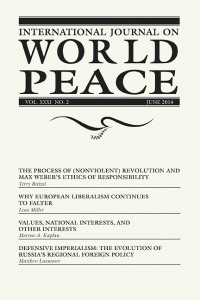
Beyond Realism: Values, Interests, Levels, and Spheres in International Relations Theory

International Journal on World Peace Posted on June 1, 2014 by Gordon AndersonJune 1, 2014

Introduction to IJWP, June 2014
IJWP-cover-2-14

From Kant’s influential Perpetual Peace to the social scientific studies of society in the twentieth century many writers argued that cultural values and economic interests needed to be satisfied to achieve a lasting peace. However, Hans Morgenthau, a highly influential professor of international politics disagreed. He wrote in 1948:

The main signpost that helps political realism to find its way through the landscape of international politics is the concept of interest defined in terms of power.1

This issue of IJWP challenges this political realism in several ways, arguing that it fails to hold state actors within the bounds of legitimate and moral use of power, that it fails to integrate economic and cultural “soft power” interests in its simplistic, black and white analyses, and that it fails to address levels of governance other than the state that are integrally tied to subsystems and international systems.

It is more important than ever to advance a more integral understanding of international relations that sees human society in terms of a set of interconnected social systems, beginning at the level of individuals, and moving through family systems and face-to-face community systems to state political economies, and finally to international organization.

There are three major spheres of influence, the political, economic, and cultural. Of these three, the political, which is the sphere of legal power and force, should be the servant of the economic and cultural spheres, rather than their master. But, power corrupts, and elites in any sphere whose powers are unchecked, will abuse that power and, like a cancer, feed off of those they are in a position to serve, creating unhappiness, inequality, and violence. This reversal of dominion is often cited as the difference between a “politician” and a “statesman.” It is what distinguishes a Nelson Mandela from the average power broker.
Continue reading →

Posted in Introductions | 1 Reply

Women and Peace, A Bad Treaty, and the Collapse of Complex Societies

International Journal on World Peace Posted on June 1, 2014 by Gordon AndersonJune 1, 2014

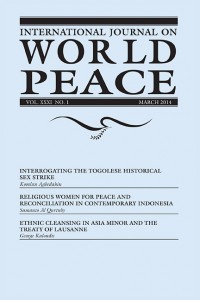
Introduction to IJWP, March 2014

IJWP March 2014The first two articles of this issue of IJWP are related to women and non-violent strategies for peace.

The first article, by Komlan Agbedahin, is about an attempt by women in Togo to use a sex strike to end the country’s political impasse. The concept dates back to the ancient Greek comedy Lysistrata by Aristophanes, first presented publicly in 411 b.c. More recently, a sex strike had been used with some success in Liberia that inspired Togolese women to attempt this method of non-violent action. The Togolese experiment, however, ended in failure. This article discusses reasons for the failure, including inadequate preparation and miscommunication and the neglect of the political, economic, and social context of Togo.
Continue reading →

Posted in Introductions | Leave a reply

Boko Haram and the State Imposition of Group Values

International Journal on World Peace Posted on December 4, 2013 by Gordon AndersonDecember 4, 2013

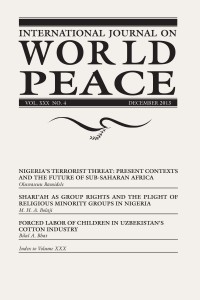
Introduction to IJWP, December 2013

IJWP, December 2013This issue of IJWP has two articles related to the Boko Haram group in Northern Nigeria and an article on child labor in Uzbekistan. Boko Haram is a northern Nigerian Islamist group that has killed thousands in campaigns of terror against Christians and others. It has sought the implementation of Shari’ah law in Nigeria and it is part of a growing alliance of international Islamist groups, spreading its influence beyond Nigeria and providing safe harbor for others, like Al Queda, in Nigeria.

Our first article, “Nigeria’s Terrorist Threat: Present Contexts and the Future of sub-Saharan Africa,” looks at the reasons for the rise and expansion of Boko Haram in poorly governed states in Northern Nigeria. It explains why military attempts to eliminate such groups often have the reverse effect of stimulating their growth, because they do nothing to eliminate the threat to traditional values and ways of life associated with secular states and the United Nations. These groups, uniting against this generalized common enemy, are in fact disparate groups and often bitterly divided among themselves and do not share common local objectives.
Continue reading →

Posted in Introductions | Leave a reply

Conflict Resolution and Virtue

International Journal on World Peace Posted on September 1, 2013 by Gordon AndersonSeptember 1, 2013

Introduction to IJWP, September 2013

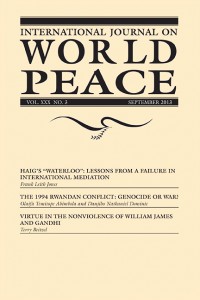
IJWP-3-13-coverThis issue of IJWP has three articles that look at conflict: types of conflict, conflict mediation, and the relation of virtue to conflict.

The first article, “Haig’s ‘Waterloo’: Lessons from a Failure in International Mediation” is a study of why and how Alexander Haig failed to negotiate a resolution to the conflict between the United Kingdom and Argentina in the dispute over the Falkland Islands. “Haig’s ‘Waterloo,’” provides a strong challenge to the assumption that the United States or any other powerful nation can broker peace between other nations because of its power. Some readers may remember Henry Kissinger’s famed “shuttle diplomacy” in the Middle East. Since then, many Americans have assumed their Secretary of State was in a unique position to meditate conflicts between other nations.

Professor Frank Leith Jones, author of this article, scoured recently declassified government documents related to Alexander Haig’s shuttle diplomacy during the Falklands/Malvinas islands dispute under the Reagan administration. Continue reading →

Posted in Introductions | Leave a reply

Rights and Abilities

International Journal on World Peace Posted on June 1, 2013 by Gordon AndersonJune 1, 2013

Introduction to IJWP, June 2013

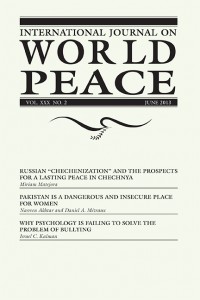
cover 2-13-72This issue of IJWP has articles on three different topics: Political stability in Chechnya, treatment of women in Pakistan, and bullying in U.S. schools. While these are quite different topics, they all relate to the general issue of rights and abilities.

Our global culture promotes concepts of human rights and democracy through the United Nations, the mass media, and many NGOs. However, human rights and democracy cannot be obtained without the ability to design structures of governance and the abilities of people living in a society to produce the things they want. Many people demand rights without having the necessary abilities to achieve them. The United Nations promotes rights, but cannot provide people with the ability to achieve them.
Continue reading →

Posted in Introductions | 2 Replies

Transparency and Peace

International Journal on World Peace Posted on March 1, 2013 by Gordon AndersonMarch 1, 2013

Introduction to IJWP, March 2013

“Do not ask for transparency from others unless you have provided transparency to them.”—Anderson’s Golden Rule of Transparency(1)

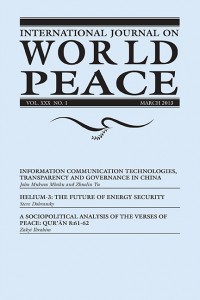
IJWP-cover-1-13This issue of IJWP has articles on three different topics: Transparency in government, competition for energy resources, and peace in the Qur’an.

Transparency is a major issue for  all social institutions, not just government, because it is an essential aspect of legitimacy in an age where there are many large, complex, and impersonal social institutions. In the family, the most basic social institution, transparency is not a serious issue because the interpersonal relationships are so close that everyone knows what everyone else in the family is doing. If little sister is sick, Dad loses his job, or big brother drives home in a new Mercedes, it is difficult to hide this information from other family members. The same is true in small towns, like my hometown, which had a population of fewer than 300 people. When I delivered the newspaper to nearly every house, and stepped into nearly every kitchen on Saturday to collect for the paper, I knew who was sick, who was on welfare, who was distraught, and who was cheating on their spouse. This “natural transparency” does not exist with the impersonal relationships in large cities or modern bureaucratic social institutions, whether they be governments, corporations, or churches. Impersonal distance creates opportunities to hide secrets in a church, to defraud government programs, to cheat on mortgage applications, to use corporate revenues for private purposes, or to engage in insider trading.

Continue reading →

Posted in Introductions | Leave a reply

Natural Nations and Abstract States

International Journal on World Peace Posted on December 3, 2012 by Gordon AndersonDecember 3, 2012

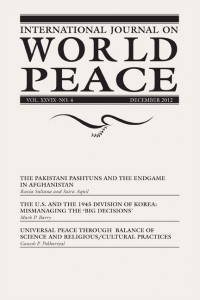
IJWP, December 2012

Introduction to IJWP, December 2012

Conflicts are produced when great powers or international organizations draw arbitrary state boundaries over areas occupied by tribal and national cultural groups. When this happens, homogeneous groups that have lived together for many generations, and that have had their identity formed by shared values and laws suddenly find themselves divided and forced to live with other tribes or national groups that hold different values. Imposed abstract state boundaries divide natural nations, disrupting normal interactions, and even separating families.

Such divisions are particularly evident in post-colonial Africa, Asia, and the Middle East, where Europeans drew administrative districts on maps over areas of land without much thought about the national self-identity of the peoples living in that territory. Such divisions are the cause of much anguish, strife, and even genocide in our world. The process of absorbing different national groups has followed conquests throughout history, and leaders of empires often left local rulers with some autonomy that honored the local values and customs. Today we are particularly aware of the after-effects of European colonization of Africa and Asia in the 19th and 20th centuries because, as Europeans withdrew, the states left behind were composed of non-natural cultural groupings not predisposed to live peacefully together.
Continue reading →

Posted in Introductions | Leave a reply

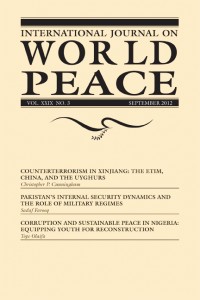
Corruption and Instability in Xinjiang, Pakistan, and Nigeria

International Journal on World Peace Posted on September 1, 2012 by Gordon AndersonSeptember 1, 2012

Introduction to IJWP, September 2012

This issue examines three states where there is political instability; Xinjiang province, Pakistan, and Nigeria. Xinjiang province is in Western China bordering Kazakhstan, Kyrgyzstan, Tajikistan, Afghanistan, and Pakistan. The largest ethnic group in the region is the Uyghurs, a Muslim group found in Central Asia, but Han Chinese are the majority in the cities. As in the case of the Tibetan Buddhists, tension exists between the Uyghurs, who do not feel they can freely practice their culture, and the Han Chinese who are increasingly populating the region.

Since 9/11, the Chinese have convinced the U.S. to label the Uyghur separatist organization, ETIM, as terrorists, based on their proximity to the Muslims in Afghanistan and Pakistan and supposed links to Al Qaeda. The first article, by Christopher Cunningham, asks whether the Uyghurs are a terrorist threat or whether Beijing has preyed on the international fear of terrorism to suppress the religious freedoms of an indigenous nationality that is defending its right to self-determination. He concludes that Beijing has likely overstated its case and the U.S. supported Beijing’s attacks on the Uyghurs to garner support for its own war on terror against Al Qaeda. Continue reading →

Posted in Introductions | Leave a reply

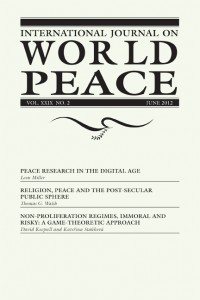
Moral Principles and Governance

International Journal on World Peace Posted on June 9, 2012 by Gordon AndersonJune 9, 2012

Introduction to IJWP, June 2012

This issue looks at the thorny problem of how social ideals and rationally grounded moral principles can guide the structures and institutions of governance. This is no small feat in our age of political realism, power politics, national self-interest, and the general temptations of power and money. Washington DC lobbying, US elections, geopolitical nuclear politics, suicide bombing, and corrupt governments around the world are all signs that rational principles, such as those framed in the US Constitution, are failing to guide social policy. Rather we see power and money being used to dictate social outcomes biased towards those who have wealth or political power.

Our first article, by Leon Miller, begins by noting that the entire field of peace research is based on the premise that scientific research and humanistic values should be applied to institutions and structures of governance.  This field is indebted to the Enlightenment emphasis on reason, the vision of Immanuel Kant outlined in Perpetual Peace, the communication ethics promoted by Karl-Otto Apel and Jurgen Habermas, the peace research writings of Elise Boulding, the economic theories of Kenneth Boulding, the political science of Quincy Wright, and the social theory of Johan Galtung. These figures played a prominent role in the interdisciplinary worldview of the International Peace Research Association and peace research centers like the University of Michigan.

Continue reading →

Posted in Introductions | 2 Replies

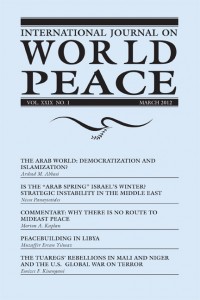
The Arab Spring A Year Later

International Journal on World Peace Posted on March 21, 2012 by Gordon AndersonMarch 21, 2012

Introduction to IJWP, March 2012

This issue focuses on the “Arab Spring” after a year has passed and three regimes in the Arab world have been toppled by waves of popular protests begun on December 18, 2010, when a Tunisian man in a remote village immolated himself. These changes are born out of frustration and idealism, and fuelled by new forms of communication like cell phones and the internet. However, the future of these countries is uncertain as there is not a clear plan for how the replacement regimes will deliver the freedom and economic development that protesters seek.

As we know from the results of the United States and French Revolutions, replacement regimes can take very different courses. In the United States, the Founders scoured the lessons of history to devise a constitution that created checks and balances on power, a constitution that limited the role of government and gave ultimate control to citizens, yet limited the bounds of popular control to prevent citizens from harming themselves by “mobocracy.” In France, idealism divorced itself from the lessons of history and sought to create a new regime based on reason. However, since most of human evolution involves non-rational values that have evolved over centuries, it was a shallow and idealistic government that did not protect the people from either revolutionary excesses or mobocracy. Continue reading →

Posted in Introductions | 4 Replies

Post navigation

← Older posts
Newer posts →

Recent Posts

  • Institutional Resilience and Peace
  • Corruption and Constructivism
  • Regional Peace and Nuclear Weapons

Recent Comments

  • Israel C. Kalman on Rights and Abilities
  • Institutional Consciousness and the Evolution of Society – Integral Society on Institutional Resilience and Peace
  • Merging Aid and Diplomacy is Trending – Will the US Follow? • New Global Perspectives on Beyond Realism: Values, Interests, Levels, and Spheres in International Relations Theory

Archives

RSS Top UN News Stories

  • Keeping hope ‘alive for younger generations’ in Haiti as funding falters
  • Nuclear disarmament at breaking point as mistrust grows – but hope remains
  • Concerns persist over herbicide spraying reports on Blue Line between Lebanon and Israel

Meta

  • Log in
  • Entries feed
  • Comments feed
  • WordPress.org

Contact Us

  • Email
    gordon@ijwp.org
  • Phone
    6516443087
  • Fax
    6516440997
  • Address
    3600 Labore Road, Suite 1
    Saint Paul, MN 55110
© 2011-2018, International Journal on World Peace - Weaver Xtreme Theme
↑