↓
 

International Journal on World Peace

Interdisciplinary Pursuit of Peace

  • Home
  • Annual Indexes
    • Volume XXXVIII, 2021
    • Volume XXXVII, 2020
    • Volume XXXVI, 2019
    • Volume XXXV, 2018
    • Volume XXXIV, 2017
    • Volume XXXIII, 2016
    • Volume XXXII, 2015
    • Volume XXXI, 2014
    • Volume XXX, 2013
    • Volume XXVIX, 2012
    • Volume XXVIII, 2011
    • Volume XXVII, 2010
    • Volume XXVI, 2009
    • Volume XXV, 2008
    • Volume XXIV, 2007
    • Volume XXIII, 2006
    • Volume XXII, 2005
    • Volume XXI, 2004
    • Volume XX, 2003
    • Volume XIX, 2002
    • Volume XVIII, 2001
    • Volume XVII, 2000
    • Volume XVI, 1999
    • Volume XV, 1998
    • Volume XIV, 1997
    • Volume XIII, 1996
    • Volume XII, 1995
    • Volume XI, 1994
    • Volume X, 1993
  • About
  • Contact

Post navigation

← Older posts
Newer posts →

Peace in an Imbalanced World

International Journal on World Peace Posted on December 1, 2011 by Gordon AndersonDecember 1, 2011

Introduction to IJWP, December 2011
December 2011 IJWP

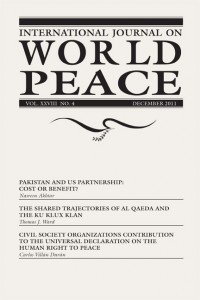
This issue of IJWP contains three articles that reveal some of the toughest challenges to peace that relate to imbalances in power, imbalances in wealth, and imbalances in the treatment of individuals and groups.

Our first article, by Nasreen Akhtar, is an analysis of Pakistan-US relations that, in many respects, complements the article on “The Obama Administration’s Strategy in Afghanistan” in the September 2011 issue of IJWP. It presents a Pakistani perspective on the challenges Pakistan may face when the United States and its allies withdraw from Afghanistan. The states occupying and attempting to stabilize Afghanistan share no common borders with it and thus will not be subject to cross-border insurgencies if they withdraw. Continue reading →
Posted in Introductions | Leave a reply

Balancing Rule of Law and Self-determination

International Journal on World Peace Posted on September 1, 2011 by Gordon AndersonSeptember 1, 2011

IJWP September 2011

Introduction to IJWP, September 2011

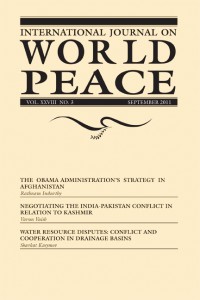
Rule of law is necessary for the order, stability, and peace of any nation.Without rule of law there is anarchy in which gangs, warlords, and conquerors compete for control to establish their own rule of law. As Augustine of Hippo said,

Even while waging a war, every man wants peace; whereas no one wants war while he is making peace. And even when men are plotting to disturb the peace, it is merely to fashion a new peace near to the heart’s desire; it is not because they dislike peace as such. It is not that they like peace less, but their own kind of peace more. And even when secession is successful, its purpose is not achieved unless some sort of peace remains among those who plotted and planned the rebellion. (City of God, Bk. XIX, Ch.12)

The “peace” of a ruler is seldom the “peace” of the ruled. While many people can be “pacified” by a ruler who gives them a measure of wealth or freedom, people generally seek self-determination. Most people consider rule by a conqueror as an occupation and oppression, and not peace. They do not want to spend their lives serving the whims of the most powerful person, making him rich and happy at their expense. Continue reading →

Posted in Introductions | Leave a reply

Nation-States, CSOs, and Second-Track Diplomacy

International Journal on World Peace Posted on June 16, 2011 by Gordon AndersonJune 16, 2011

IJWP June 2011

Introduction to IJWP, June 2011

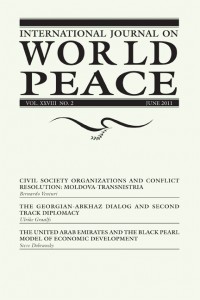
As the Soviet empire collapsed around 1990, there was great hope that the many peoples whose national identities had been suppressed would get their own nation-states. The ideal of a nation-state as the normal form of society has been emblazoned on Western consciousness since the Peace of Westphalia in 1648. However, a “nation-state” implies a “culture on a territory” and in Europe today there are few, if any, territories with homogeneous cultures. This was especially true of both the former Yugoslavia and the former USSR, where there were many migrations and intermarriages under the umbrella of secular socialist regimes.

With the breakup of the Soviet Union, many small territories have sought their independence as nation-states, some of these are Nagorno-Karabakh, Abkhazia, South Ossetia, and Transnistria. These regions are called “frozen conflict zones” because of their unsettled status since 1992. They operate somewhat autonomously within states. Continue reading →

Posted in Introductions | 2 Replies

The Chinese Miracle, Turkey, and Zionism

International Journal on World Peace Posted on March 15, 2011 by Gordon AndersonMarch 15, 2011

IJWP March 2011

Download .pdf from Paragon House, $5.95

Introduction to IJWP, March 2011

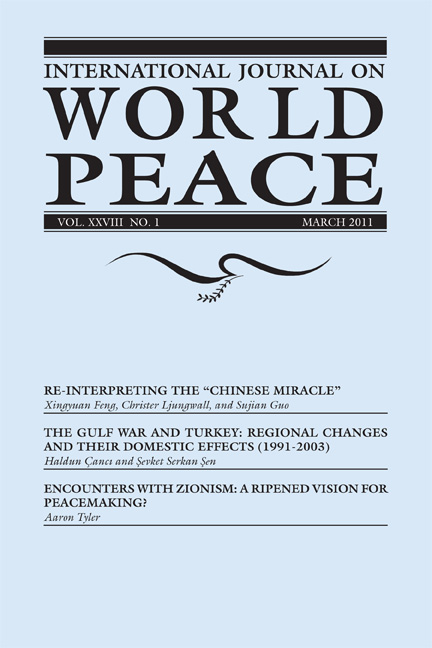
This issue of IJWP contains articles on three different topics, Chinese economic growth, politics in Turkey, and Zionism.

The first article, “Re-Interpreting the ‘Chinese Miracle’” by Xingyuan Feng, Christer Ljungwall, and Sujian Guo seeks to explain the phenomenal growth of the Chinese economy over the last thirty years. Naturally, other societies will want to learn how the Chinese have accomplished this growth. They argue that existing explanations do not do justice to the topic, and that the lenses through which analysts have viewed China’s economic development have generally been too narrow to fully explain the phenomenon. The authors argue that a combination of piecemeal “social engineering” and “spontaneous order,” as theorized by Hayek, were responsible.

Continue reading →

Posted in Introductions | Leave a reply

Research on Democracy

International Journal on World Peace Posted on December 1, 2010 by Gordon AndersonDecember 1, 2010

Download .pdf from Paragon House, $5.95

IJWP December 2010

Introduction to IJWP, December 2010

This issue of IJWP focuses on democracy: how to establish it and its relation to violence. We continue from the September issue’s last article “Internal vs. External Requisites of Democracy” by Kunihiko Imai with two additional research articles related to democracy.

The first article, by Gary A. Stradiotto and Sujian Guo, is on “Transitional Modes of Democratization and Democratic Outcomes.” This is particularly significant for people who make plans to implement democracy, since how democracy is implemented, and by whom, is very important in determining whether a democracy will survive ten years or longer.

While the conclusion that democracies work best when they are created out of cooperative transitions, rather than by imposition, may seem common sense, many of today’s leading countries and international organizations still try to impose democracy on people living in non-democratic societies. Perhaps this research will help bolster arguments against many of the efforts by global elites to impose democracy through regime change or as a criterion for receiving international loans or assistance. Democracy is something that people have to feel they own, that they control, and that allows them to pursue an unfettered life. Continue reading →

Posted in Introductions | 1 Reply

The Importance of Systems Theory in Politics

International Journal on World Peace Posted on September 22, 2010 by Gordon AndersonSeptember 22, 2010
IJWP September 2010

IJWP September 2010

Download .pdf from Paragon House, $5.95

Introduction to IJWP, September 2010

Twenty-five years ago, from August 16-20, 1985, the Professors World Peace Academy sponsored a conference on “The Fall of the Soviet Empire: Prospects for Transition to a Post-Soviet World,” organized by Professor Morton A. Kaplan of the University of Chicago and Lithuanian-born Soviet scholar Alexander Shtromas, who was teaching at the University of Salford in the UK. As an insider, Shtromas was one of the world’s most knowledgeable experts on the Soviet system. I was the secretary for the conference held in Geneva, Switzerland, in which over 90 research papers on all aspects of Soviet society were discussed.

In this issue of International Journal on World Peace, our first articles will take a retrospective look at the thought about the future of the Soviet Union and the international order at the time, some of the recommendations of Morton A. Kaplan and others, the collapse that came more quickly than most of those at the conference predicted, and opportunities for a more peaceful international order lost.

Continue reading →

Posted in Introductions | Leave a reply

Resolving Ethnic Conflicts in Nation States

International Journal on World Peace Posted on June 28, 2010 by Gordon AndersonJune 28, 2010

Download .pdf from Paragon House, $5.95

Introduction to IJWP, June 2010

With the rise of the sovereign nation-state, after the Peace of Westphalia in 1648, came a period of great scientific and technical advancement as well as the rise of national and international wars in which millions of people have perished. The modern state, which has the capacity for efficiently providing rule of law in which large populations can live peacefully, is more often than not a tool used by powerful people to exploit masses, or an instrument of power through which to seek world dominance.

The United Nations Security Council, organized by the major powers after two devastating world wars and the development of weapons of mass destruction, has provided deterrence against powerful states entering into traditional wars against other states. However, the state, as the center of sovereign power, has been the target for control by unscrupulous individuals and groups everywhere. The result is a world in which individuals and groups are oppressed by those who control state power. Continue reading →

Posted in Introductions | Leave a reply

Power Politics in Southwest Asia

International Journal on World Peace Posted on March 16, 2010 by Gordon AndersonMarch 16, 2010

[singlepic id=104 w=125 h=187 float=right]Intro­duc­tion to March 2010 IJWP

We can better understand the War on Terror and the role of Western military forces in Iraq, Afghanistan, and Pakistan by learning the history of the politics in the region. Southwest Asia is marked by many weak state governments and competition for control of them by more powerful neighbors, international superpowers, and non-state actors that include religious jihadists and independence movements. In the September 2009 issue of IJWP we discussed anarchy in unsecured territories, with an emphasis on Africa. Southwest Asia suffers from many of the same political dynamics: (1) state borders that were created by past political conquest, either by expansion by indigenous rulers or conquest by colonial masters, (2) the collapse of European colonialism and the rise of the bi-polar world of the Cold War that had rewarded dictatorial allies, (3) the collapse of the Soviet Union and the rise of hopes around the world for self-rule, and (4) new contests for state power based on self-determination movements, regional hegemons, and non-state religious and ideological actors.

Continue reading →

Posted in Introductions | Leave a reply

Realpolitik and World Peace

International Journal on World Peace Posted on December 21, 2009 by Gordon AndersonDecember 21, 2009

Introduction to December 2009 IJWP

Realpolitik is a term derived from German. It refers to a politics based on practical and material factors rather than on theoretical or ethical objectives (Merriam-Webster dictionary). Historically, many political platforms have been based on theoretical, religious, ideological, or moral arguments.

Most visions of ideal societies, as disparate as Plato, Confucius, Jesus, and Marx, all rely on changing basic human behavior. If we can only learn to love one another, to share with one another, to accept a Christian, Muslim, or socialist theory of justice, or change our selfish and exploitative behavior in some way, then we can create an ideal world. As we recently learned from the efforts of the Soviet Union to create a “new man,” one that is rational and scientific, the laws of nature are not easily trumped. Instead of getting a “new man” who gives according to his abilities and receives according to his needs, the Soviet Union got the Nomenklatura, the “old man” in a new bureaucratic class, who used position and power in the Soviet political system for personal and selfish desires.
Continue reading →

Posted in Introductions | Leave a reply

Anarchy in Unsecured Territories

International Journal on World Peace Posted on September 5, 2009 by Gordon AndersonSeptember 5, 2009

Introduction to September 2009 IJWP

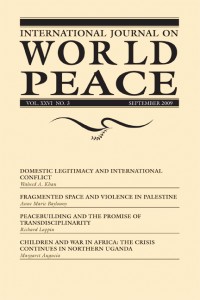
The modern desire for democracy and self-rule is largely a reaction against a history of oppression and exploitation following military conquest and imposed rule. World history is predominantly shaped by conquerors, yet most people desire to live their own lives and not serve as a means to someone else’s ends. While self-rule requires the overthrow of imposed rule, it is more difficult than the mere overthrow of a regime and the declaration of freedom and of rule of law. Self-rule requires self-discipline and the willingness to use force, when necessary, against foreign aggression and civil violence. Continue reading →

Posted in Introductions | Leave a reply

Post navigation

← Older posts
Newer posts →

Recent Posts

  • Institutional Resilience and Peace
  • Corruption and Constructivism
  • Regional Peace and Nuclear Weapons

Recent Comments

  • Israel C. Kalman on Rights and Abilities
  • Institutional Consciousness and the Evolution of Society – Integral Society on Institutional Resilience and Peace
  • Merging Aid and Diplomacy is Trending – Will the US Follow? • New Global Perspectives on Beyond Realism: Values, Interests, Levels, and Spheres in International Relations Theory

Archives

RSS Top UN News Stories

  • Keeping hope ‘alive for younger generations’ in Haiti as funding falters
  • Nuclear disarmament at breaking point as mistrust grows – but hope remains
  • Concerns persist over herbicide spraying reports on Blue Line between Lebanon and Israel

Meta

  • Log in
  • Entries feed
  • Comments feed
  • WordPress.org

Contact Us

  • Email
    gordon@ijwp.org
  • Phone
    6516443087
  • Fax
    6516440997
  • Address
    3600 Labore Road, Suite 1
    Saint Paul, MN 55110
© 2011-2018, International Journal on World Peace - Weaver Xtreme Theme
↑